Introduction to Pet Food Texture and Its Importance
When it comes to pet food, texture is more than just a sensory feature; it plays a significant role in the product’s quality, palatability, and overall consumer satisfaction. Just as texture influences human food preferences, it affects pets’ enjoyment and digestion of their food. Pet food texture refers to the mechanical properties that determine how the food feels, breaks, and behaves when chewed or manipulated. These qualities are critical for ensuring pets receive food that is both tasty and easy to consume.
In the process of developing and evaluating pet food products, shear strength y shear force tests are essential tools for understanding how a material responds to mechanical forces. These tests provide insight into the texture of pet food, helping manufacturers design products that meet the needs of both pets and pet owners.
Understanding Shear Strength and Shear Force Tests
Shear strength is a material’s ability to withstand forces that cause it to break or deform. In the case of pet food, shear strength can influence how easily the food can be chewed, crushed, or bitten into by pets. This is particularly important for ensuring that dry pet food or treats are not too hard to chew but still maintain structural integrity.
En ensayo de fuerza cortante is a specific method used to measure the force required to cut or break a sample along a particular plane. In pet food, this test simulates the action of a pet chewing or biting into a piece of food. By evaluating the shear force, manufacturers can determine whether the food is easy to chew while maintaining its intended texture, whether it is crunchy or soft.
Shear tests are typically conducted with the help of a texture analyzer, a precision instrument that applies controlled forces to the pet food sample. The data generated from these tests can include force measurements, which reflect how much energy is required to break the food under specific conditions.
The Process of Food Texture Analysis
Food texture analysis involves the quantitative measurement of a food product’s mechanical and structural properties under controlled deformation forces. The goal is to understand how food reacts to stress, including compression, tension, shear, and bending forces. For pet food, this analysis is crucial for determining attributes such as:
- Hardness: How firm or soft the food is.
- Cohesiveness: How well the food holds together when bitten.
- Springiness: How quickly the food returns to its original shape after compression.
- Adhesiveness: How sticky or tacky the food might feel.
These characteristics are important in ensuring that pet food is not only enjoyable for pets but also meets nutritional and safety standards.
Texture analysis is performed using a texture analyzer, which applies specific probes (e.g., cylinder, blade, or needle) to the pet food sample. A load cell measures the force applied, and the displacement or deformation is tracked, often in millimeters. By analyzing these data points, manufacturers can generate stress-strain curves, which help characterize the food’s response to various forces.
Why Pet Food Texture Matters
The texture of pet food can affect its palatability, digestibility, and even its safety. For example, dry kibble must be crunchy enough to encourage chewing, but it should not be so hard that it becomes a choking hazard. Similarly, wet food should have a texture that appeals to pets while also being easy to scoop and serve.
Food texture analysis can also help optimize product formulations by providing objective data on the consistency and performance of pet food products. This data can guide the development of new recipes, troubleshoot production issues, and ensure that the final product meets quality control standards.
How to Conduct Pet Food Texture Testing
To conduct shear force tests and other food texture analysis procedures, a texture analyzer is essential. One such device is the Analizador de texturas TEX-01 from Cell Instruments. This precision instrument is designed to apply controlled forces to food samples and measure the resulting deformation. It offers:
- Customizable Test Programs: Set specific parameters such as force, speed, and probe type to suit different pet food textures.
- Reliable Data: Collect real-time data on force, displacement, and other key texture properties.
- Versatility: Suitable for testing a variety of food types, from dry kibble to moist treats.
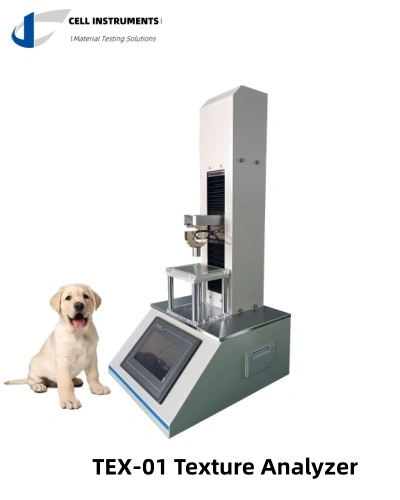
With the Analizador de texturas TEX-01, pet food manufacturers can accurately measure the shear strength and other textural properties, ensuring the final product meets both quality and consumer expectations.
Conclusion
Pet food texture is a vital aspect of product development, directly influencing pet enjoyment and product performance. Shear strength y shear force tests are essential tools for evaluating and optimizing the texture of pet food. By using food texture analysis, manufacturers can ensure their products meet the necessary standards for consistency, palatability, and safety.
For accurate and reliable texture testing, the Analizador de texturas TEX-01 from Cell Instruments provides the precision needed to measure and optimize the mechanical properties of pet food, ensuring that every product is as effective and enjoyable as possible.
 ES
ES  EN
EN  AR
AR  BG
BG  CS
CS  DA
DA  DE
DE  EL
EL  ET
ET  FI
FI  FR
FR  HU
HU  ID
ID  IT
IT  JA
JA  KO
KO  LT
LT  LV
LV  NB
NB  NL
NL  PL
PL  PT
PT  RO
RO  RU
RU  SK
SK  SL
SL  SV
SV  TR
TR  UK
UK